A home with a garden of drought-tolerant plants is seen in https://www.walmart.com/browse/patio-garden/landscaping/5428_4091_1229594 Beverly Hills, April 8, 2015. California's cities and towns would be required to cut their water usage by up to 35 percent or face steep fines under proposed new rules released Tuesday, the...more
Reuters /
Wednesday, April 08, 2015
A home Sprinkler System with a Sprinkler System Installation garden of drought-tolerant plants is seen in Beverly Hills, April 8, 2015. California's cities and towns would be required to cut their water usage by up to 35 percent or face steep fines under proposed new rules released Tuesday, the state's first-ever mandatory cutbacks in urban water use amid ongoing drought.
That's his job and his alone. A former village sign painter he now paints coach stripes, as they're properly called, on Rolls-Royce cars at the company's Goodwood, England factory. His job is the last step in the manufacturing process and if he messes up that line... He just can't mess up that line. There is no eraser that will fix it. The paint has special properties that instantly bond it to the underlying car paint.
That's serious pressure, so the proper mental state is important.
"This is just another car to me," he said. "If you start worrying about who owns them or where it's going, it'll play with your mind. Then you'll never do it. You just got to be able to learn to shut off and do what you need to do."
He rarely takes time off because it would cause him to lose his focus.
"Weekends are bad enough," he said, "because now I have to refocus and I have come back into it again."
When there's time off at the factory -- when the the plant's being retooled to build a new model, for instance -- Court usually travels to various parts of the world to paint customers' cars or to display his skills in public exhibitions.
Tall and burly with a thick, rolling accent, Court looks and sounds like just the sort of man who you could imagine painting English pub signs. That's what he used to do before he came here. He applied for the the Rolls-Royce job as soon as he heard the automaker would open a factory in his rural village in 2003.
"For me, it was just adapting a skill that I already had to a technique for doing six meters of car," he said.
Six meters is about 20 feet -- the length of a roughly $500,000 Rolls-Royce Phantom.
Photos - Cool cars from the Geneva Motor Show
A skill like Court's wasn't easy to find. He was flown to Germany to meet with Ian Cameron, the man BM W had hired to head up Rolls-Royce design. BMW had bought the Rolls brand a few years earlier. Cameron showed him a perfect hand-painted coach line.
"It was a case of 'Can you do that?'" Court recalled. "Well, I'm a cocky Englishman. I can do anything."
Former sign painter Mark Court now paints the coach stripes on Rolls-Royce cars at the automaker's Goodwood, England, factory.
From there, Court was sent to BMW's motorcycle factory, the only part of the company, at that time, that did hand-painted lines. He perfected his craft painting gas tanks and fairings, the shell that goes over the frame of some racing-style motorcycles.
Court uses squirrel hair brushes that he trims himself to just the right shape. He powders his fingers so they slide easily across the car's smooth painted surface as he follows a guide line made from tape. The tape doesn't mask the edge of the line, it's purely a guide from which he keeps a set distance.
His job involves much more than just straight lines, though. Customers also request a variety of custom designs including flowers, horse heads, various abstract shapes and, of course, their initials. He spent hours painting lines and flowers on Rolls-Royce's Serenity show car that was unveiled at the Geneva Motor Show this year.
He's still trying to find an apprentice to someday take his place. So far http://commons.wikimedia.org/wiki/Category:Painters two apprentices have dropped out. One was his own son, who decided to go to work in Rolls-Royce's wood shop, instead.
"Time marches on," Court said. "I ain't getting no younger. Someones got to continue."
CNNMoney (New York) First published April 30, 2015: 11:36 AM ET
Most people believe all electricians are simply electricians. In reality, all electricians are not equal. As electricians advance through their careers they meet a few milestones, go through different levels of education and training, and take and pass different exams.
Classifications differ Electrician Service College Station from state to state and a classification you might see in one, doesn't exist in another. Many states avoid statewide licensing and actually leave the licensing responsibility up to cities and counties. Below are the most common classifications we see for Electricians in the United States..
Apprentice Electrician
Most states and local governments that require licensing in order to become an electrician have an apprentice classification. This is the entry level position in the electrical trade. Apprentice electricians learn the trade by working directly with an experienced , licensed electrician. The type of work and work hours are logged and verified by their employer as proof to the licensing authority that they have work experience before being permitted to advance to the next level in their career.
Apprentice electricians are also typically required to enroll in electrician courses while working. These courses are usually offered at local community colleges or through trade schools. These courses are important in helping to understand the Best Electrician Service National Electrical Code, how http://www.sears.com/tools-electricians-tools/b-1219224682 to read blueprints and other information to keep the job site safe.
Journeyman Electrician
Most, but not all states have a Journeyman electrician classification. Typically, a journeyman electrician is required to have between 2 and 4 years of experience and has to pass an exam specific to the journeyman classification. As the next level in the electrical trade, a journeyman is higher on the pay scale and has more responsibilities. This is because of their experience and knowledge developed over the years.
A journeyman is typically able to work on his own, instead of being supervised, and in many areas he is even allowed to supervise apprentice electricians and verify their work experience. A journeyman classification does not mean that the learning ends. Continuing education courses are required by the local or state licensing boards as a way to ensure a journeyman is up to date on the electrical codes.
Master Electrician
In states with a master electrician classification, this is the highest level an electrician can achieve. A master electrician will have between 4 and 8 years of experience before they are able to apply for this top level license. This license offers the highest pay scale and the most responsibility. A master electrician will supervise apprentice, and in some areas even journeyman electrician and verify their work experience.
Once again, the learning doesn't stop for the master electrician. Continuing education courses are required by the local or state licensing boards as a way to ensure a master electrician is up to date on the electrical codes.
We've just outlined the three most common classifications for electricians. Your state may offer more or fewer classifications. Some states, for instance, further break down journeyman and master electricians into residential, commercial and industrial journeyman and master electricians. Check with your state or local jurisdiction for the classifications and requirements in your area.
A garden is a planned space, usua lly outdoors, set aside for the display, cultivation, and enjoyment of plants and other forms of nature. The garden can incorporate both natural and man-made materials. The most common form today is known as a residential garden, but the term garden has traditionally been a more general one. Zoos, which display wild animals in simulated natural habitats, were formerly called zoological gardens.[1][2] Western gardens are almost universally based on plants, with garden often signifying a shortened form of botanical garden.
Some traditional types of eastern gardens, such as Zen gardens, use plants sparsely or not at all. Xeriscape gardens use local native plants that do not require irrigation or extensive use of other resources while still providing the benefits of a garden environment. Gardens may exhibit structural enhancements, sometimes called follies, including water features such as fountains, ponds (with or without fish), waterfalls or creeks, dry creek beds, statuary, ar bors, trellises and more.
Some gardens are for ornamental purposes only, while some gardens also produce food crops, sometimes in separate areas, or sometimes intermixed with the ornamental plants. Food-producing gardens are distinguished from farms by their smaller scale, more labor-intensive methods, and their purpose (enjoyment of a hobby rather than produce for sale). Flower gardens combine plants of different heights, colors, textures, and fragrances to create interest and delight the senses.
Gardening is the activity of growing and maintaining the garden. This work is done by an amateur or professional gardener. A gardener might also work in a non-garden setting, such as a park, a roadside embankment, or other public space. Landscape architecture is a related professional activity with landscape architects tending to specialise in design for public and corporate clients.
Contents
1 Etymology
2 Garden design
3 Designs for the Perfect Ga rden
4 Elements of a garden
5 Uses for the garden space
6 Types of gardens
7 Environmental impacts of gardens
8 Watering gardens
9 Wildlife in gardens
10 Climate change and gardens
11 In religion, art, and literature
12 Other similar spaces
13 See also
14 Notes
15 External links
Etymology
Nicosia municipal gardens, Cyprus
The etymology of the word gardening refers to enclosure: it is from Middle English gardin, from Anglo-French gardin, jardin, of Germanic origin; akin to Old High German gard, gart, an enclosure or compound, as in Stuttgart. See Grad (Slavic settlement) for more complete etymology.[3] The words yard, court, and Latin hortus (meaning "garden," hence horticulture and orchard), are cognates--all referring to an enclosed space.[4]
The term "garden" in British English refers to a small enclosed area of land, usually adjoining a building.[5] This would be referred to as a yard in American English.
Garden design
Main article: Garden design
Garden design is the creation of plans for the layout and planting of gardens and landscapes. Gardens may be designed by garden owners themselves, or by professionals. Professional garden designers tend to be trained in principles of design and horticulture, and have a knowledge and experience of using plants. Some professional garden designers are also landscape architects, a https://www.amazon.com/Lawn-Garden-Sprinklers/b?ie=UTF8&node=553974 more formal level of training that usually requires an advanced degree and often a state license.
Elements of garden design include the layout of hard landscape, such as paths, rockeries, walls, water features, sitting areas and decking, as well as the plants themselves, with consideration for their horticultural requirements, their season-to-season appearance, lifespan, growth habit, size, speed of growth, and combinations with other plants and landscape features. Consideration is also given to the maintenance needs of the garden, including the time or funds available for regular maintenance, which can affect the choices of plants regarding speed of grow th, spreading or self-seeding of the plants, whether annual or perennial, and bloom-time, and many other characteristics. Garden design can be roughly divided into two groups, formal and naturalistic gardens.[6]
The most important consideration in any garden design is, how the garden will be used, followed closely by the desired stylistic genres, and the way the garden space will connect to the home or other structures in the surrounding areas. All of these considerations are subject to the limitations of the budget. Budget limitations can be addressed by a simpler garden style with fewer plants and less costly hardscape materials, seeds rather than sod for lawns, and plants that grow quickly; alternatively, garden owners may choose to create their garden over time, area by area.
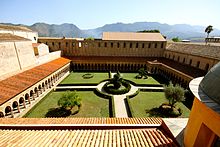
Example of a garden attached to a place of worship: the cloister of the Abbey of Monreale, Sicily, Italy
The Sunken Garden of Butchart Gardens, Victoria, British Columbia
Gardens of Versailles (France)
The back garden of the Umaid Bhawan Palace in Jodhpur, India
Tropical garden in the Faculty of Science, National University of Singapore in Singapore
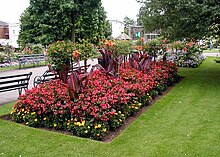
Flower-bed with the date in Lignano Sabbiadoro, Italy
Gardens at Colonial Williamsburg, Williamsburg, Virginia, feature many heirloom varieties of plants.
Shitenn?-ji Honbo Garden in Osaka, Osaka prefecture, Japan - an example of a zen garden.
Designs for the Perfect Garden
Gardenesia
Greenery enclosures are for yards and family play fields, as well as be ideal areas for capacity sheds wherein one can just essentially stock unused family unit stuffs in the shed. As a component of the whole house outside, it is just however legitimate that garden sheds will likewise look adequate and in-in respect to the house's outline.
Elements of a garden
Garden at the centre of intersection in Shanghai.
Naturalistic design of a Chinese garden incorporated into the landscape, including a pavilion
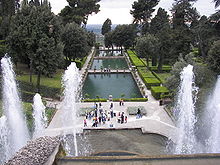
Garden with Fountains, Villa d'Este, Italy.
Most gardens consist of a mix of natural and constructed elements, although even very 'natural' gardens are always an inherently artificial creation. Natural elements present in a garden principally comprise flora (such as trees and weeds), fauna (such as arthropods and birds), soil, water, air and light. Constructed elements include paths, patios, decking, sculptures, drainage systems, lights and buildings (such as sheds, gazebos, pergolas and follies), but also living constructions such as flower beds, ponds and lawns.
Uses for the garden space
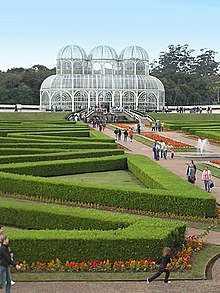
Partial view from the Botanical Garden of Curitiba (Southern Brazil): parterres, flowers, fountains, sculptures, greenhouses and tracks composes the place used for recreation and to study and protect the flora.
A garden can have aesthetic, functional, and rec reational uses:
Cooperation with nature
Plant cultivation
Garden-based learning
Observation of nature
Bird- and insect-watching
Reflection on the changing seasons
Relaxation
Family dinners on the terrace
Children playing in the garden
Reading and relaxing in the hammock
Maintaining the flowerbeds
Pottering in the shed
Basking in warm sunshine
Escaping oppressive sunlight and heat
Growing useful produce
Flowers to cut and bring inside for indoor beauty
Fresh herbs and vegetables for cooking
Types of gardens
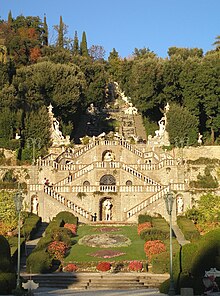
A typical Italian garden at Villa Garzoni, near Pistoia
Checkered garden in Tours, France
Zen garden, Ry?an-ji
French formal garden in the Loire Valley
Bristol Zoo, England
Castelo Branco, Portugal
Hualien, Taiwan
The Italian gardens of El Escorial, Spain
An ornamental garden in the Auburn Botanical Gardens, Sydney, Australia
Gardens may feature a particular plant or plant type(s);
Gardens may feature a particular style or aesthetic:
Bonsai
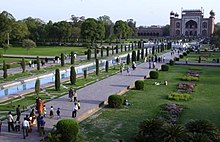
Chinese garden
Dutch garden
English landscape garden
Gardens of the French Renaissance
French formal garden
French landscape garden
Italian Renaissance garden
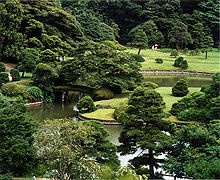
Japanese garden
Knot garden
Korean garden
Mughal garden
Natural landscaping
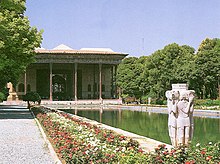
Persian garden
Roman gardens
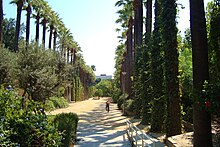
Spanish garden
Terrarium
Trial garden
Tropical garden
Water garden
Wild garden
Xeriscaping
Zen garden
Types of garden:
Botanica l garden
Butterfly garden
Butterfly zoo
Chinampa
Cold frame garden
Community garden
Container garden
Cottage garden
Cutting garden
Forest garden
Garden conservatory
Green wall
Greenhouse
Hanging garden
Hydroponic garden
Market garden
Rain garden
Raised bed gardening
Residential garden
Roof garden
Sacred garden
Sensory garden
Square foot garden
Vertical garden
Walled garden
Windowbox
Zoological garden
Environmental impacts of gardens
Gardeners may cause environmental damage by the way they garden, or they may enhance their local environment. Damage by gardeners can include direct destruction of natural habitats when houses and gardens are created; indirect habitat destruction and damage to provide garden materials such as peat, rock for rock gardens, and by the use of tapwater to irrigate ga rdens; the death of living beings in the garden itself, such as the killing not only of slugs and snails but also their predators such as hedgehogs and song thrushes by metaldehyde slug killer; the death of living beings outside the garden, such as local species extinction by indiscriminate plant collectors; and climate change caused by greenhouse gases produced by gardening.
Watering gardens
Some gardeners manage their gardens without using any water from outside the garden, and therefore do not deprive wetland habitats of the water they need to survive. Examples in Britain include Ventnor Botanic Garden on the Isle of Wight, and parts of Beth Chatto's garden in Essex, Sticky Wicket garden in Dorset, and the Royal Horticultural Society's gardens at Harlow Carr and Hyde Hall. Rain gardens absorb rainfall falling onto nearby hard surfaces, rather than sending it into stormwater drains.[7] For irrigation, see rainwater, sprinkler system, drip irrigation, tap water, greyw ater, hand pump and watering can.
Wildlife in gardens
Chris Baines's classic book 'How to make a wildlife garden'[8] was first published in 1985, and is still a good source of advice on how to create and manage a wildlife garden.
Climate change and gardens
Climate change will have many impacts on gardens, most of them negative, and these are detailed in 'Gardening in the Global Greenhouse' by Richard Bisgrove and Paul Hadley.[9] Gardens also contribute to climate change. Greenhouse gases can be produced by gardeners in many ways. The three main greenhouse gases are carbon dioxide, methane, and nitrous oxide. Gardeners produce carbon dioxide directly by overcultivating soil and destroying soil carbon, by burning garden 'waste' on bonfires, by using power tools which burn fossil fuel or use electricity generated by fossil fuels, and by using peat. Gardeners produce methane by compacting the soil and making it anaerobic, and by allowing their compost heaps to become compacted and anaerobic. Gardeners produce nitrous oxide by applying excess nitrogen fertiliser when plants are not actively growing so that the nitrogen in the fertiliser is converted by soil bacteria to nitrous oxide. Gardeners can help to prevent climate change in many ways, including the use of trees, shrubs, ground cover plants and other perennial plants in their gardens, turning garden 'waste' into soil organic matter instead of burning it, keeping soil and compost heaps aerated, avoiding peat, switching from power tools to hand tools or changing their garden design so that Sprinkler System Mckinney power tools are not needed, and using nitrogen-fixing plants instead of nitrogen fertiliser.[10]
Wolfgang Amadeus Mozart's opera La finta giardiniera
Frances Hodgson Burnett's The Secret Garden
Elizabeth von Arnim's novels Elizabeth and Her German Garden and Solitary Summer
John Steinbeck's short-story The Chrysanthemums
John Berendt's novel Midnight in the Garden of Good and Evil
In Daphne du Maurier's novel "Rebecca" the unnamed narrator discovers that her husband loves his house and garden at Manderley so much that he murdered his first wife, Rebecca, when she told him she was pregnant with somebody else's child and that the child would inherit Manderley.
Other simil ar spaces
Other outdoor spaces that are similar to gardens include:
A landscape is an outdoor space of a larger scale, natural or designed, usually unenclosed and considered from a distance.
A park is a planned outdoor space, usually enclosed ('imparked') and of a larger size. Public parks are for public use.
An arboretum is a planned outdoor space, usually large, for the display and study of trees.
A farm or orchard is for the production of food stuff.
A botanical garden is a type of garden where plants are grown both for scientific purposes and for the enjoyment and education of visitors.
A zoological garden, or zoo for short, is a place where wild animals are cared for and exhibited to the public.
A Kindergarten is a preschool educational institution for children and in the very sense of the word should have access or be part of a garden.
A Mnnergarten is a temporary day-care and activities space for men in German-spe aking countries while their wives or girlfriends go shopping. Historically, the expression has also been used for gender-specific sections in lunatic asylums, monasteries and clinics.[11]
See also
Around the World in 80 Gardens
B?gh
Baug
Bottle garden
Climate-friendly gardening
Community gardening
Garden centre
Garden tourism
Gardener
Gardening
Heritage Gardens in Australia
History of gardening
Hortus conclusus
List of botanical gardens
List of companion plants
List of gardens
Museum of Garden History
National Public Gardens Day
Paradise, originally from an Iranian word meaning "enclosed," related to Garden of Eden
Verde Pulgar, a software application that assists with gardening
The Victory Garden TV series
Walled garden
Water garden
Notes
^ Garden history: philosophy and design, 2000 BC--2000 AD, Tom Tu rner. New York: Spon Press, 2005. ISBN 0-415-31748-7
^ The earth knows my name: food, culture, and sustainability in the gardens of ethnic Americans, Patricia Klindienst. Boston: Beacon Press, c2006. ISBN 0-8070-8562-6
^ "Etymology of the modern word gardin". Merriam Webster.
^ "Etymology of words referring to enclosures, probably from a Sanskrit stem. In German, for example, Stuttgart. The word is generic for compounds and walled cities, as in Stalingrad, and the Russian word for city, gorod. Gird and girdle are also related". Yourdictionary.com. Archived from the original on 2010-02-13.
^ The Compact Oxford English Dictionary
^ Chen, Gang (2010). Planting design illustrated (2nd ed.). Outskirts Press, Inc. p.3. ISBN978-1-4327-4197-6.
^ Dunnett and Clayden, Nigel and Andy (2007). Rain Gardens: Managing Water Sustainably in the Garden and Designed Landscape. Portland, Oregon, USA: Timber Press. ISBN978-0881928266.
^ Baines, Chris (200 0). How to make a wildlife garden. London: Frances Lincoln. ISBN978-0711217119.
^ Bisgrove and Hadley, Richard and Paul (2002). Gardening in the Global Greenhouse: The impacts of climate change on gardens in the UK. Oxford: UK Climate Impacts Programme.
^ Ingram, Vince-Prue, and Gregory (editors), David S., Daphne, and Peter J. (2008). Science and the Garden: The scientific basis of horticultural practice. Oxford: Blackwell. ISBN9781405160636.
^ See: Jakob Fischel, Prag's K. K. Irrenanstalt und ihr Wirken seit ihrem Entstehen bis incl. 1850. Erlangen: Enke, 1853, OCLC14844310 (German)
External links
Wikiquote has quotations related to: Garden
Media related to Garden at Wikimedia Commons
Media related to Gardens at Wikimedia Commons
Media related to Gardens by type at Wikimedia Commons
Media related to File:CIA_memorial_garden_with_stone.jpg at Wikimedia Commons
Wikisource has the text of the 1911 Encyclopdia Britannica article garden.
Wikibooks' A Wikimanual of Gardening has more about this subject:
gardening
v
t
e
Horticulture and gardening
Gardening
History
Design
computer-aided
Garden tool
Green wall
Arboretum
Allotment
Butterfly
Community
Forest
French intensive
Guerrilla
Garden
Historic conservation
Landscape
Native
Parterre
Raised bed
Square foot
Sustainable
Xeriscaping
Types of gardens
Back
Biblical
Botanical
Butterfly
Byzantine
Cactus
Chinese
Color
Container
Cottage
Dutch
English
Fernery
Floating
Flower
French
formal
landscape
Renaissance
Front
Greek
Greenhouse
Hanging
Hgelkultur
Islamic
Italian
Japanese
Kitchen
Knot
Korean
Market
Mary
Monastic
Mughal
Orangery
Orchard
Persian
Bagh
Charbagh
Paradise
Philosophical
Pleasure
Roman
Spanish
Rain
Rose
Roof
Sacred
Scottish
Sculpture
Sensory
Shade
Therapeutic
Trial
Tropical
Victory
Vineyard
Walled
Water
Wildlife
Winter
Zen
Zoological
Horticulture
Agriculture
stock-free
sustainable
urban
Arboriculture
Botany
Companion planting
Crop
most valuable
Flora
Floriculture
Fruticulture
Genetically modified tree
Hydroculture
Indigenous
Intercropping
Landscape architecture
Oenology
Olericulture
Plant
breeding
propagation
drought tolerance
hardiness
Pomology
Postharvest physiology
Tropical
Urban
agriculture
horticulture
forestry
reforestation
Viticulture
Organic
Biodynamic agriculture
List of organic gardening and farming topics
Vegan organic gardening
Plant protection
Fungicide
Herbicide
Index of pesticide articles
List of fungicides
Pesticide
Plant disease forecasting
Pruning
Weed control
Agriculture and agronomy portal
Gardening portal
Commons
Authority control
GND: 4019286-6
NDL: 00572757
Retrieved from "https://en.wikipedia.org/w/index.php?title=Garden&oldid=785337002"


 Former sign painter Mark Court now paints the coach stripes on Rolls-Royce cars at the automaker's Goodwood, England, factory.









 Media related to Garden at Wikimedia Commons


 Agriculture and agronomy portal
 Gardening portal

